Instituto Portugues do Mar e Atmosfera - Homepage

  • Who we are | 
  • Where we are | 
  • Scientific Council | 
  • Research | 
  • eLibrary | 
  • ipma encyclopedia  | 
  • Contacts | 
  • Português
  • Weather
    • Weather forecast
    • 10 days and hourly forecast
    • Weather Warnings
    • Meteorological charts
    • Vertical profile
    • Satellite observations
    • Radar
    • Lightning
    • Solar Radiation
    • Online weather stations
    • World forecast
    • Tropical cyclones forecast
    • Report a meteorological phenomenon?
  • Seismic
    • Seismic maps
    • Shakemap
    • Felt an earthquake?
    • Moment Tensor
    • Networks
    • Bulletins
    • Projects
  • Sea
    • Beaches and ports
    • Marine forecast
    • Significant wave height
    • Sea peak period
    • Surface current
    • Sea surface temperature
    • Sea surface height
  • Climate
    • Climate Monitoring
    • Climate Normals
    • Daily monitoring
    • Long data series
    • Monthly monitoring
    • Drought
    • Greenhouse gases
    • Climate Extremes
    • Climate web portal
    • Climate Services
  • Bivalves
    • Bivalves - Situation point
    • Legislation and Documents
    • Production areas
    • Biotoxins
    • Phytoplankton
    • Contaminants Metals
    • Microbiology
    • Bivalves - historical
  • Fisheries
    • Disclosure
    • Projects
    • Fish management
    • ICES
  • Aeronautic
    • TAF and METAR
    • Selfbriefing
    • Know more
  • Agriculture
    • Soil Moist Index
    • Vegetation Health Index (VHI)
    • Fraction of Absorbed Radiation (FAPAR)
    • More information
    • Agroclimatic platform
  • Health
    • Ultra-violet index
    • Ozone
    • Pollen
  • Vessels
    • Framework
    • RV Mário Ruivo
    • RV Diplodus
    • Maris
    • Recife II
    • Cardium
  • Space
    • MSG satellite
  • Rural Fires
    • Mainland Rural Fire Danger
    • Madeira Rural Fire Danger
    • Reports Rural Fire Danger
IPMA>Media Center>News

IPMA deployed new floats
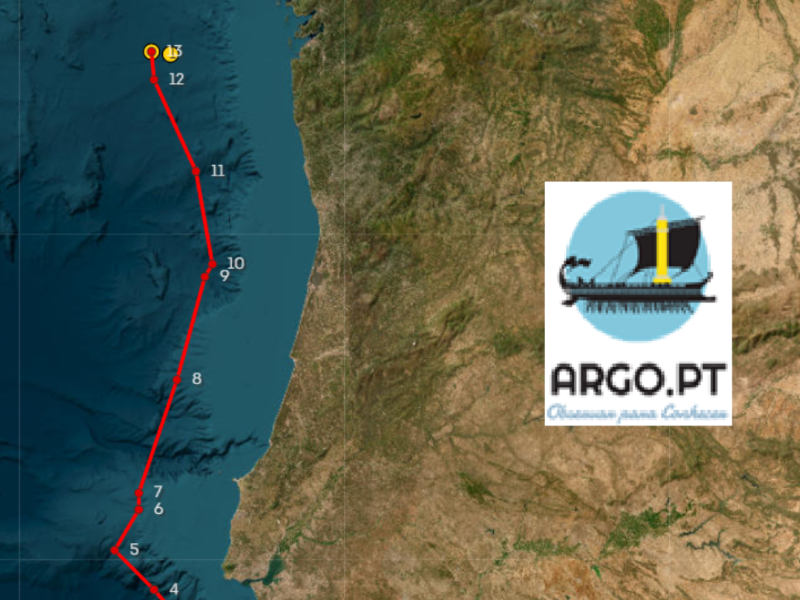
2025-12-03 (IPMA)

IPMA is the national focal point for the Argo Program and a member of the Argo Steering Team (AST). The Argo Program is part of the Global Ocean Observing System (GOOS) of UNESCO Intergovernmental Oceanographic Commission (IOC), as well as the Global Climate Observing System (GCOS). Argo is a global ocean observing network composed of around 4,000 autonomous profiling floats operating throughout the world’s oceans. IPMA is developing and implementing Argo.PT, Portugal’s contribution to these observing programmes.

IPMA recently deployed three new Argo floats under the Argo.PT Program. The deployments took place during the AMPO2025 oceanographic cruise aboard the Portuguese Navy vessel NRP D. Carlos I, representing a significant reinforcement of national participation in this international GOOS monitoring effort. Each Argo float autonomously measures temperature, salinity, and pressure down to 2,000 metres depth, and can estimate ocean currents at 1,000 metres. Data are transmitted via satellite in near-real time. One of the floats launched by Portugal is a full Biogeochemical Argo (BGC-Argo) float, which also measures dissolved oxygen, chlorophyll, dissolved organic matter, pH, nutrients, downwelling irradiance, and suspended particles, thus expanding the scientific value of the observations collected. These measurements are essential for understanding the ocean’s role in Earth’s climate system and for improving meteorological and oceanographic forecasting.

One of the deployed floats was named Argonauta and signed by students from Miraflores Secondary School as part of the Escola Azul (Blue School) programme, during a visit to IPMA’s facilities in Algés. During the visit, students learned about ocean monitoring instruments, particularly Argo floats that collect real-time data and share information internationally. The Argonauta float that also measures dissolved oxygen, is now operational, allowing students to follow its trajectory, view its data, and better understand how global ocean observing networks function (https://fleetmonitoring.euro-argo.eu/float/5906997).

These Argo floats were funded by the projects “OBSERVA.PT – Observations aboard national commercial vessels to support the protection and restoration of biodiversity in Portuguese marine ecosystems” (MAR-01.04.02-FEAMP-0002), co-funded by the Mar2020 Operational Programme, and “Atlantic Observatory – Data and Monitoring Infrastructure”, funded by the EEA Grants.

IPMA thanks the crew of NRP D. Carlos I and highlights that this initiative reinforces Portugal’s commitment to ocean observation and protection, advancing scientific knowledge on climate and marine ecosystems.


Imagens associadas
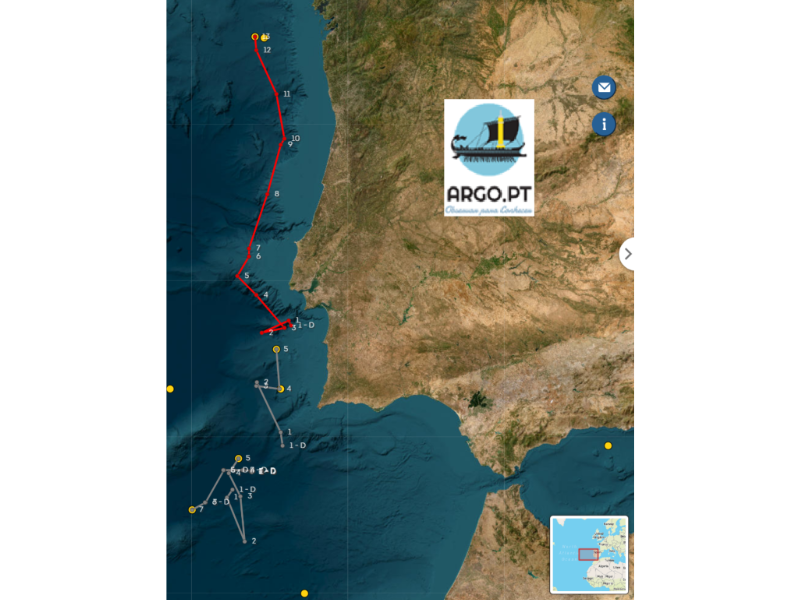
  • Argo.PT float trajectories on November 26th, 2025. In red are the float deployed from SV Libries on July 21st, 2025. In grey the three floats deployed during oceanographic cruise AMPO2025. The “Argonauta” float is the grey one that did a “V” trajectory in the beginning.

    Argo.PT float trajectories on November 26th, 2025. In red are the float deployed from SV Libries on July 21st, 2025. In grey the three floats deployed during oceanographic cruise AMPO2025. The “Argonauta” float is the grey one that did a “V” trajectory in the beginning.


Media Center

  • Entrance Media Center
  • News
    • 2025
    • 2024
    • 2023
    • 2022
    • 2021
    • 2020
    • 2019
    • 2018
    • 2017
    • 2016
    • 2015
    • 2014
    • 2013
    • 2012
  • Press Releases
  • Multimedia
  • Disclosures

Follow us on

  • icon facebook Facebook
  • icon twitter Twitter
  • icon youtube Youtube
  • icon Educast IPMA Educast


  • Media

    • News
    • Communiqué
    • Lectures / workshops
    • YouTube
    • IPMA on Educast
  • Social network

    • Facebook
    • Facebook - Azores
    • Twitter
    • Instagram
  • Services

    • Products and services
    • RSS
    • Apps Android
    • Apps Apple
    • PDA
  • Information

    • Contact
    • Useful links
    • Research scholarship
    • EEAGrants projects
    • ECMWF
  • About site

    • Accessibility
    • Legal warnings
    • Site Map
  • Web projects

    • Observar
    • Subscriptions
    • Survey
    • E-learning
    • Shakemap
 
  • Apcer - A marca da Certificação
  • Lisboa:
        UTC:

    Copyright © Portuguese Institute for Sea and Atmosphere 2025
  • Ministério da Agricultura e Mar