
Estação Piloto de Piscicultura de Olhão
IPMA has a Aquaculture Research Center in Olhão (EPPO), a unique infrastructure in the country, designed to carry out research, development and experimental demonstration on a pilot scale. The aim of these facilities is also to promote the transfer of technology to the productive sector, being an important pillar in scientific and technical training, both at the professional and university levels.
This unit occupies an area of approximately 7 hectares of the Ria Formosa Natural Park in Marim, and consists of a maternity area (with breeders of 9 species of marine fish adapted to captivity), a pre-fattening area and a fattening area in earthen ponds, in monoculture, polyculture or multitrophic systems.
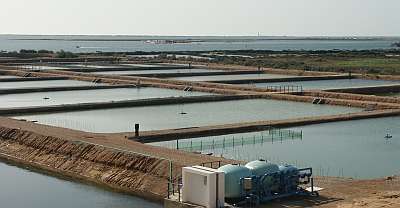 Pilot Fish Farming Station in Olhão (EPPO)
At EPPO, reproduction, larval development and fattening trials are carried out for various species, with special emphasis on gilthead seabream, European seabass, as well as new species such as white seabream, grouper, sole and croaker. Studies are also carried out at the level of physiology, nutrition, pathology and fattening trials of fish in polyculture of various species and in multitrophic systems (e.g., fish and oysters).
Associated with this unit is an offshore cage installed for open sea fish farming tests.
This unit plays an important role in both professional and academic training, regularly hosting students from national and international educational institutions as well as members of the productive sector. At the same time, it has sought good coordination with the different actors involved in the development of aquaculture, especially public entities and the productive sector, with the aim of offering effective collaboration. href="/opencms/bin/images.site/pescas/eppo/EEAA-3-tanques.jpg" title="EEAA-3-tanques">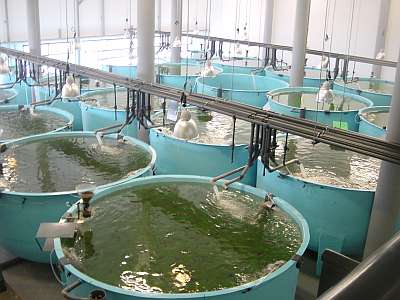 EEAA - Tanks, at the Pilot Fish Farming Station in Olhão (EPPO)
Scientific research and various trials are co-financed by national and European research projects. The trials in the various phases of the production cycle, and especially in earthen ponds, are carried out on a pilot scale, so as to be representative and transferable to the productive sector, resulting in a fish production that can be made available to charitable institutions, as it is a product produced in accordance with best sustainability practices and that respects the rules of quality and food safety.
The research and activities developed at EPPO are supported through projects within the scope of national and international funding programs.
The scientific activity at EPPO also prioritizes national and international collaborations with other research institutes and universities, thus fostering the exchange of knowledge, as well as the mobility of researchers.
It is also worth highlighting the collaborations with companies through protocols or scientific projects, led by national and international companies.
Documents
AQUA&AMBI
- Compatibilidade da aquacultura e outras atividades económicas em áreas naturais protegidas
- Guia básico sobre a Aquacultura Biológica em Portugal e Espanha
- Guia básico de Aquacultura em Sistema Multi-trófico Integrado em Esteiros
- Guia básico de Aquacultura em Sistema Multi-trófico Integrado em Tanques de Terra
- Guia básico Boas Práticas na Produção de Ostras
- Guia para produção de ostras a partir da fixação natural e recuperação populações naturais nas zonas intertidais
Comics - The path to the Aquaculture
- Download Comics (78MB)
AQUATRANSFER
- Cultivo Multitrófico Integrado
- Identificação de Bactérias
- Bem Estar Animal
- Transporte de animais marinhos vivos
- Biotecnologia
- Salinas
- Boas Práticas Produção de Ostra
- Ferramentas moleculares na investigação em aquacultura
- Identificação de sexos e estados de maturação de gónadas de peixe
- Malformações esqueléticas em piscicultura marinha
- Importância do período larvar na qualidade do produto final